
Key takeaways
- Tanning gummies work by depositing dietary carotenoids (astaxanthin, lycopene) into skin and subcutaneous fat.
- The effect is pigmentation, not UV-induced melanin. No sun. No DHA. No fake tan.
- Clinical evidence supports doses of 4 to 12 mg astaxanthin and 5 to 16 mg lycopene daily.
- Most people see visible warmth at weeks 3 to 4. Full tone at weeks 6 to 8.
- Beta carotene, used by most other tanning gummies, causes carotenoderma (orange palms and soles) at supplement doses.
- ChUV uses 11 mg astaxanthin and 5.5 mg lycopene per gummy, matching doses in published human trials.
Do tanning gummies work?
Yes, certain tanning gummies work, but through pigmentation, not a sun-style tan. Tanning gummies that contain clinical doses of dietary carotenoids (astaxanthin, lycopene) deposit those pigments in skin and subcutaneous fat over 4 to 8 weeks, producing a measurable warm, golden tone that human raters consistently identify as healthier and more attractive than an equivalent melanin tan (Whitehead et al., 2012; Alaluf et al., 2002). The caveat: tanning gummies built on beta carotene or under-dosed carotenoid blends do not produce a natural tone and often cause the orange palm cast known as carotenoderma. The mechanism only works at the doses used in published human trials, which is why ChUV formulates to 11 mg astaxanthin and 5.5 mg lycopene per gummy.
The carotenoid pathway
Carotenoids are a family of fat-soluble plant pigments (reds, oranges, and yellows) that are absorbed through the gut, transported by lipoproteins, and preferentially stored in tissues rich in subcutaneous fat, including skin. Once deposited, they alter how the skin reflects light, producing a tone that reads as warm, healthy, or sun-kissed. This phenomenon is called carotenoid-based pigmentation, and it is well documented in human clinical research.
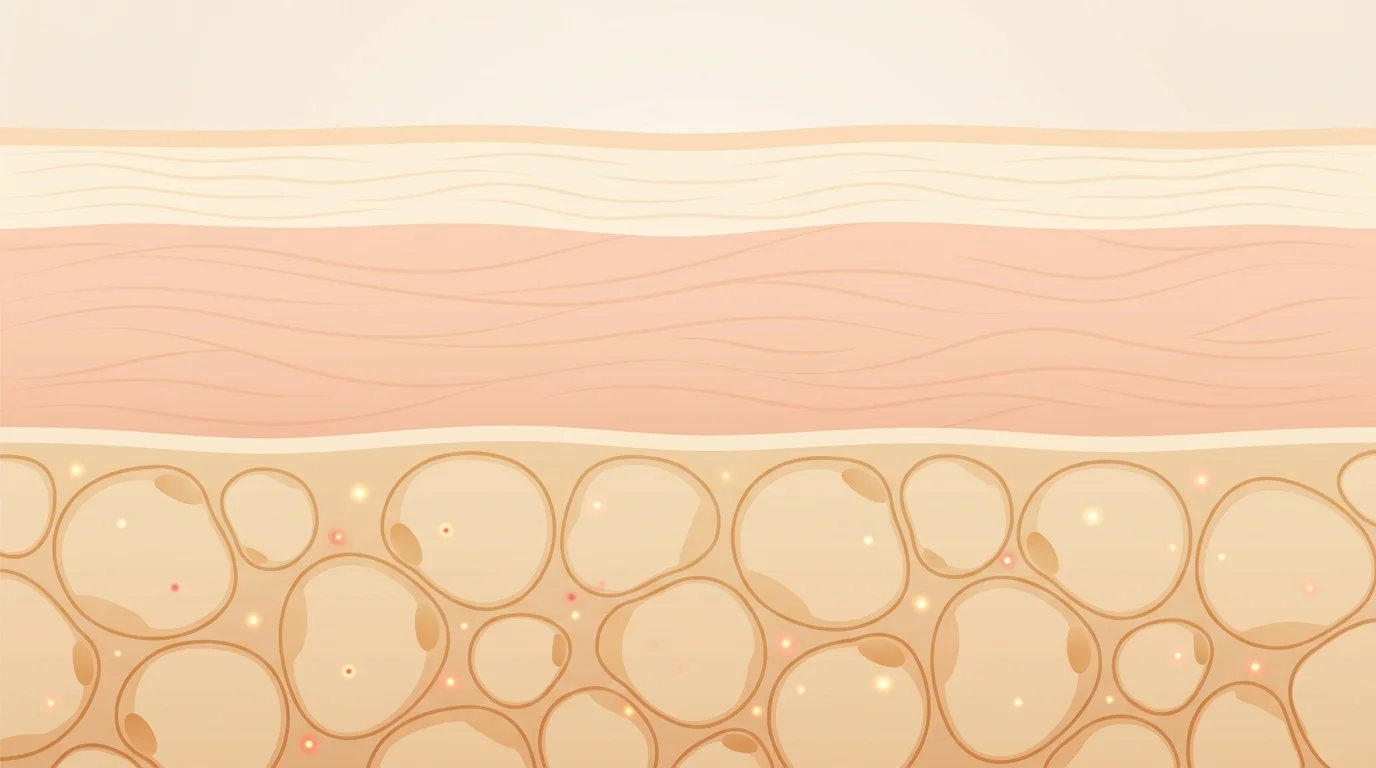
In a 2012 paper in PLoS ONE, Whitehead and colleagues showed that within-subject increases in fruit and vegetable intake produced measurable carotenoid-based skin yellowness that human raters judged more attractive and healthier-looking than equivalent-lightness melanin tan. The implication: skin color from carotenoids is not just a cosmetic result, it carries a biological signal.
It is not UV-induced melanogenesis (what a tanning bed or the sun triggers). It is not dihydroxyacetone (DHA) staining dead corneocytes on the surface (what a spray tan does). It is internal, pigment-based, and reversible with diet.
Why astaxanthin and lycopene
Not all carotenoids behave the same way in skin. ChUV tanning gummies are formulated around two that have the strongest human clinical evidence for skin benefit and the cleanest tonal payoff:
- Astaxanthin, a red-orange xanthophyll from Haematococcus pluvialis microalgae. In supplement trials, astaxanthin reduces UV-induced oxidative stress and supports a warm skin tone at doses around 4 to 12 mg per day (Ito 2018; Tominaga 2012).
- Lycopene, the red pigment in tomatoes. Stahl and Sies (2007) showed that carotenoids like lycopene measurably increased the minimum erythemal dose (MED), the amount of UV needed to redden the skin, after roughly 10 weeks.
The ChUV daily tanning gummy uses 11 mg of astaxanthin and 5.5 mg of lycopene per gummy. Those doses map directly to the ranges used in the published studies.
One gummy a day. Clinical doses. Cumulative carotenoid pigmentation. That is the entire mechanism.
The 4 to 8 week timeline
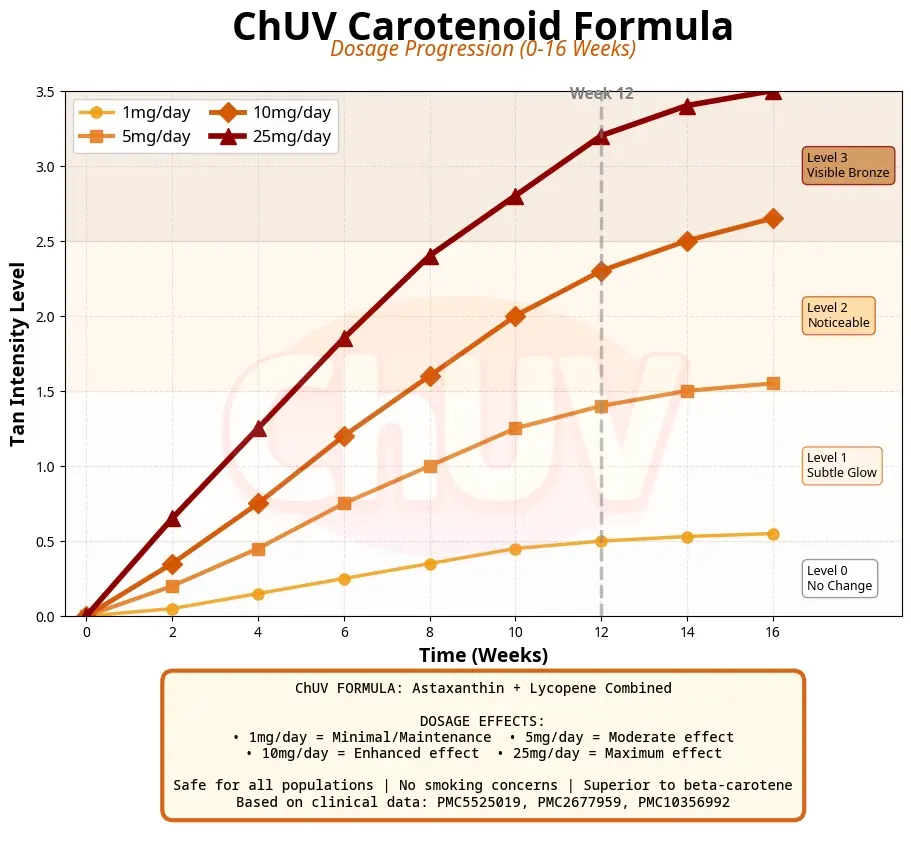
Carotenoid pigmentation is cumulative, not immediate. Blood levels rise within days, but the visible tonal shift in skin follows a slower curve as pigment deposits in subcutaneous fat.
- Week 1 to 2: Serum carotenoid levels climbing. No visible change.
- Week 3 to 4: First noticeable warmth, usually the face, chest, and hands.
- Week 6 to 8: Full expression of the tone. Most clinical outcomes hit steady-state here.
Stop supplementing, and the color gradually fades as your body clears the pigment, usually over 4 to 6 weeks. That is a feature, not a bug: the color is a function of your current carotenoid status, not a permanent change.
Why not beta carotene
Most tanning gummies on the market rely on beta carotene, a pro-vitamin A carotenoid that is cheap and extremely visibly pigmenting. The problem: at supplement doses, it tips past warm tone into an unmistakable orange cast, a condition called carotenoderma, that shows first in the palms, soles, and nasolabial folds.
Astaxanthin and lycopene produce a richer, more neutral warm tone and do not cluster the pigment in the orange-yellow corner of the color wheel. We wrote a separate pillar on this if you want to go deeper.
Clinical citations
Every claim on this page is anchored to human clinical research. These are the primary references:
Ito N, Seki S, Ueda F. (2018)
Nutrients 10(7):817
Double-blind RCT. 4 mg/day astaxanthin for 9 weeks preserved skin moisture and suppressed UV-induced wrinkle formation in healthy adults vs. placebo.
View on PubMed (PMID 29941810)Tominaga K, Hongo N, Karato M, Yamashita E. (2012)
Acta Biochim Pol 59(1):43-47
Two human trials showed 6 mg/day oral astaxanthin improved skin elasticity, wrinkles, and moisture content.
View on PubMed (PMID 22428137)Alaluf S, Heinrich U, Stahl W, Tronnier H, Wiseman S. (2002)
J Nutr 132(3):399-403
Dietary carotenoids measurably contribute to normal human skin color and reduce UV photosensitivity.
View on PubMed (PMID 11880562)Heinrich U, Gärtner C, Wiebusch M, et al. (2003)
J Nutr 133(1):98-101
12-week RCT. Oral beta-carotene (24 mg/day) or mixed carotenoids (8 mg each of beta-carotene, lycopene, lutein) reduced UV-induced erythema vs. placebo.
View on PubMed (PMID 12514275)Davinelli S, Nielsen ME, Scapagnini G. (2018)
Nutrients 10(4):522
Review documenting astaxanthin skin deposition, photoprotective mechanisms, and attenuation of UV-induced damage.
View on PubMed (PMID 29690549)Park JS, Chyun JH, Kim YK, et al. (2010)
Nutr Metab (Lond) 7:18
Human RCT. 2 to 8 mg/day astaxanthin for 8 weeks lowered DNA damage biomarker 8-OHdG and C-reactive protein.
View on PubMed (PMID 20205737)
Who tanning gummies are for
Good fit:
- People who want a natural warm tone without UV exposure.
- People whose skin does not tan easily, or who cannot spend time in the sun.
- People who dislike the orange cast of spray tans or beta carotene.
Not a fit:
- Anyone looking for instant color before an event (use bronzer or makeup instead).
- Anyone who wants to replace sunscreen. Carotenoids offer internal photoprotection; topical SPF still matters for prolonged exposure.
That is the mechanism, the evidence, and the timeline. The product just does the rest.